Bridge the gap between academia and the semiconductor industry. Transition from logic fundamentals to advanced AMBA protocols and industry-standard verification methodologies.
An actionable, industry-aligned roadmap engineered for career transformation.
Compressed learning cycle for maximum retention and skill acquisition.
Go beyond theory with live coding sessions and real-world datasets.
Build a professional portfolio that stands out to top-tier recruiters.
Industry-recognized credentials to validate your Core expertise.
Introduction to VLSI & Course Roadmap (Frontend vs Backend, RTL vs Verification)
Basics of Computer Architecture (ISA, CPU, Memory hierarchy, Buses)
Digital Electronics Part-1 (Logic gates, K-map, Combinational circuits)
Digital Electronics Part-2 (Sequential circuits, FF, Latch, Counters, FSM intro)
FSMs Deep Dive (Moore vs Mealy, State diagrams ? RTL design)
Timing Concepts (Setup/Hold, Clock Skew, STA basics)
Overview of Verilog and Timing Region of Verilog
Timeline
Phase 27A: VLSI Foundations - course roadmap, computer architecture basics, digital electronics (combinational & sequential), FSM deep dive, timing concepts, and Verilog overview.
SystemVerilog for RTL (Data types, Operators, always_comb, always_ff)
SystemVerilog for Verification (Classes, OOP, Randomization basics)
Mailbox, Queue, Event, Semaphores in SV
Testbench Architecture (Stimulus, Monitor, Scoreboard, Coverage)
Assertions (SVA Basics)
Immediate & Concurrent Assertions
Mini Project - UART RTL + Testbench (Code)
Timeline
Phase 27B: SystemVerilog RTL & Verification - RTL coding styles, verification OOP, mailbox/queue/event handling, testbench architecture, assertions, and UART mini project.
Memory Design: Single-port/ Dual-port RAM (RTL + TB)
FIFO Design & Verification (Asynchronous FIFO, CDC basics)
Clock Domain Crossing (CDC techniques: Synchronizers)
Constraints in SystemVerilog
Mini Project - I2C Spec Discussion
Mini Project - I2C RTL + Verification Testbench
Timeline
Phase 27C: Memory Design & Verification - RAM design, FIFO verification, CDC synchronizers, SystemVerilog constraints, and I2C mini projects (spec + RTL + testbench).
AMBA Overview (APB, AHB, AXI introduction, timing diagrams)
APB Protocol - Part 1 (SPECIFICATION)
APB Protocol - Part 2 (CODE IMPLEMENTATION)
AHB Protocol - Part 1 (Read channel, bursts, VALID/READY handshake)
AHB Protocol - Part 2 (Write channel, response, ordering rules and code)
AXI Protocol - Part 1 (Read channel, bursts, VALID/READY handshake)
AXI Protocol - Part 2 (Write channel, response, ordering rules)
AXI Protocol - Coding Day (RTL + Verification TB)
SystemVerilog Coverage & Assertions for Protocol Verification (APB/AXI)
Final Wrap-Up + Career Guidance in VLSI + Live Q&A
Timeline
Comprehensive AMBA protocol training with coding, verification, and career guidance.
Gain hands-on experience using the same toolchains employed by top-tier semiconductor companies.
Real challenges. Real solutions. Your portfolio will feature these production-grade applications.
Design and verify UART communication using RTL implementation and simulation-based testbench.
Learn More arrow_forwardDesign I2C RTL and validate functionality using a simulation testbench based on protocol specifications.
Learn More arrow_forwardDevelop and verify AHB/AXI protocol-based designs including bursts, VALID/READY handshakes, and ordering rules.
Learn More arrow_forwardTransforming learners into industry-ready AI professionals.
| Skill Category | Before Pantech | After Internship |
|---|---|---|
| Skill Category | Before Pantech | After Internship |
| Design Skills | Basic knowledge of logic gates |
check
Complex FSM and RTL design for high-speed protocols
|
| Verification | Basic Verilog testbenches |
check
Industry-standard UVM/SystemVerilog Testbench Architectures
|
| Protocol Knowledge | Awareness of simple serial communication |
check
Deep expertise in AMBA AXI/AHB/APB bus protocols
|
A step-by-step journey from digital basics to advanced verification engineering.
Mastering Computer Architecture, Digital Electronics, and Timing Analysis (STA).
1Learning SystemVerilog for Verification, OOP, and Testbench Architecture.
2Implementing FIFO, Memory, and CDC techniques with asynchronous designs.
3Developing AXI/AHB protocols and completing the final capstone project.
4Engage in rigorous coding challenges to sharpen your RTL development and debugging skills.
Daily hands-on coding for RTL modules and testbench components.
Deep-dive discussions into hardware specs before implementation.
Refine verification quality using Functional Coverage and SystemVerilog Assertions.
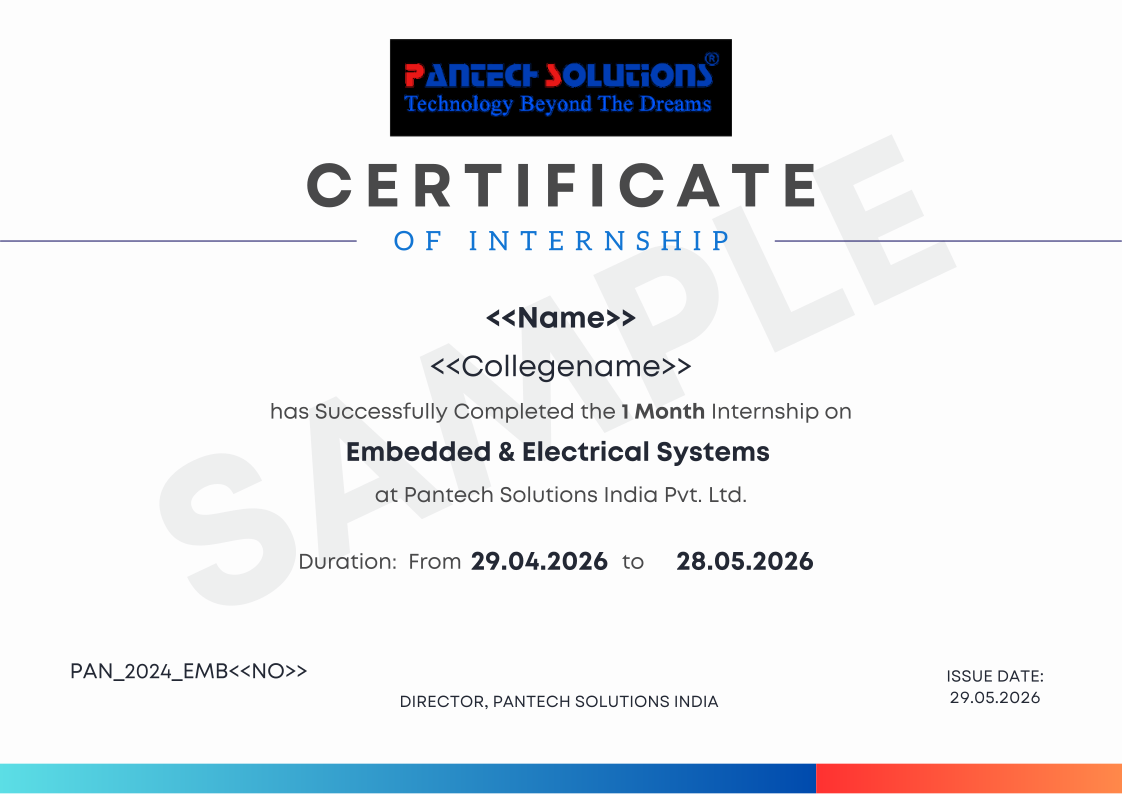
Validate your skills with a certificate that carries weight. Our credentials are recognized by leading tech firms across the country.
Unique QR code for instant digital verification
LinkedIn-ready digital credential
Increases visibility in recruiter searches
Official seal from Pantech Solutions
Status
Verified Intern
The certificate acknowledges the learner’s participation in structured training, industry‑oriented project development, and practical implementation under professional guidance.
This is to certify that the learner has successfully completed the Certification Program with Pantech. This professional certification formally recognizes the learner’s achievement, confirming their participation in structured training, guided project work, and practical implementation during the program.
A prestigious joint certification from SVNIT and Pantech. Note: Need to pay extra Rs.500 for service charges.
Select the program that matches your career goals and current expertise level.
1 Month - Rs. 999 + GST
Perfect for beginners. Master the core fundamentals and build your first industry-standard projects.
2 Month - Rs. 1899 + GST
For those with basic knowledge. Deep dive into advanced architectures and professional workflows.
3 Month - Rs. 2499 + GST
Designed for final year students and professionals. Focus on deployment, scaling, and leadership.
Our alumni are driving innovation at the world's most prestigious technology and consulting firms.
"The Advanced VLSI Design & Verification Masterclass was an exceptional experience. It provided practical exposure to modern semiconductor methodologies, covering topics such as CMOS circuit design, RTL to GDSII flow, low-power techniques, and timing analysis. Hands-on sessions with industry-standard EDA tools like Cadence, Synopsys, and Mentor Graphics gave me a complete view of the design cycle from specification to physical implementation. This workshop enhanced my technical skills, deepened my appreciation for integrated circuit complexity, and strengthened my confidence in pursuing a career in VLSI and semiconductor technology."
VLSI Masterclass Participant
"The Advanced VLSI Design course was an excellent learning experience. The 30-day free program was well-structured and highly informative, with each topic explained clearly through practical examples that made complex concepts easy to understand. The instructors were knowledgeable and engaging, creating sessions that were both interactive and impactful. I truly appreciate the opportunity to learn such an advanced subject free of cost, as it strengthened my fundamentals and motivated me to explore further in chip design. This was a valuable and inspiring course."
Advanced VLSI Course Participant
"The VLSI Design & Verification Masterclass sessions were very well designed, covering all the key topics in an interactive way. The trainer explained concepts clearly and ensured that every doubt was addressed. It was a concise yet impactful learning experience. Thank you to the team for organizing such a valuable program!"
VLSI Masterclass Participant
Everything you need to know about the AI Internship program.
Yes, Phase 1 starts with foundational digital electronics and computer architecture to ensure a smooth transition to advanced topics.
The internship is available in both Offline and Online modes with recorded sessions available for 24/7 access.
Yes, you will work extensively with simulation tools like QuestaSim/MelSim for waveform analysis and RTL validation.